Most "Amazon FBA launch checklist" articles are written for the seller standing in front of Seller Central. This one is written from the other end of the wire — the factory floor that has to produce, label, and pack socks that survive Amazon's receiving process without prep delays, relabeling fees, or listing suppressions. The distinction matters because socks are a hosiery-category product with their own compliance labels, their own size map, and their own packaging traps. When you know what the factory can do for you before the goods ship, the FBA launch stops being a scramble at the warehouse and becomes a specification you wrote in week one.
Quick answer: a private-label sock FBA launch needs four documents from your factory, not one: the tech pack, the FTC-compliant fiber label copy (English fiber content in descending order, country of origin, care symbols), the size map translated from the factory's grading table, and the packaging spec (polybag gauge, suffocation warning, barcode placement). Most FBA prep disasters trace to one of these four being improvised after production instead of specified before it. Factories that ship to Amazon vendors regularly can apply barcodes, polybag with warnings, and carton- level labels at the line — ask before you pay a prep center to redo it.
The Compliance Label: Three Lines That Cannot Be Wrong
Hosiery sold into the US market carries an FTC textile label. Three elements are non-negotiable: fiber content in English, listed in descending order by weight (the 80/15/5 blend must read exactly as knit — see our blend guide for why zone-level differences complicate this), country of origin ("Made in China" for our programs), and the manufacturer's RN or full company name. Care instructions belong on the label or the hang tag; Amazon's hosiery category checks labels at receiving and at returns, and listings get suppressed for label faults, not just products.
Two practical notes from the floor. First, printed woven labels cost more than heat-transfer but survive fifty washes — returns driven by rubbed-off labels are a quiet margin killer. Second, if your factory knits zone-differentiated blends, the label states the whole-body average; get the zone table in writing with your tech pack so a component challenge has an answer.
The Size Map: Where Factory Grading Meets Amazon Fields
Amazon asks sock sellers for a size map — the size field on the listing must match Amazon's expected size tokens for the hosiery class. The factory's grading table, not your guess, is the source: each knit size maps to a foot-length range, and that range is what Amazon's size guide displays. Our sock size chart guide covers the grading curves; the FBA step is making sure each Parent-Child variant's size token matches the knit size the factory actually produced. A mismatch between the listing size map and the physical product is a returns engine, and socks have no try-before-buy forgiveness.
Variants: color is the theme that sells. In the hosiery class, Parent-Child families typically group by color or by multi-pack structure — size variants belong in the size map fields, not as separate child listings unless the knit genuinely differs. Get the variant architecture right at listing creation; restructuring later orphaned reviews is a self-inflicted wound.
Packaging Spec: The Polybag Decides Your Fees
Socks inbound to FBA generally arrive polybagged, and the bag carries three requirements: a suffocation warning (printed bag or applied label), the scannable FNSKU barcode on a flat, unobstructed surface, and dimensions that do not push the unit into a higher size tier. Dimensional weight is the quiet one — a stiff header card that makes the package rigid can change the shipping-tier math; a soft polybag with the header card inside keeps the unit flexible. Our packaging guide-in-progress covers header card economics; the FBA point is that packaging choices are fee choices.
Ask the factory to quote FNSKU labeling and polybagging at the line. For Chinese hosiery programs this is routine work — the label stock is cheap, the application is fast, and it eliminates the prep-center step entirely. The same applies to carton-level work: shipping marks, carton counts, and per-carton ASIN segregation that make receiving faster are all factory-side tasks if specified in the purchase order.
The Checklist Itself: Factory-Side vs Seller-Side
Run this split before the deposit goes out.
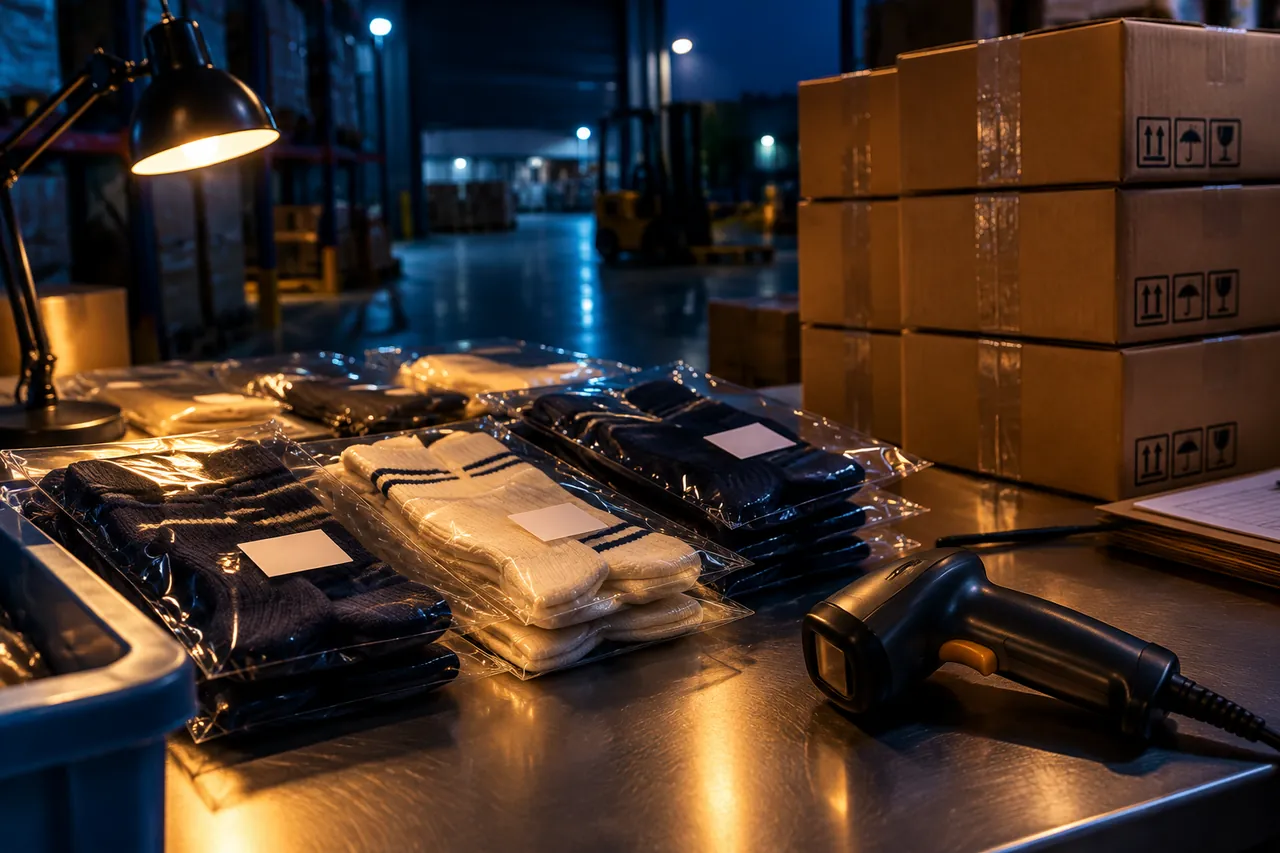
Factory-side (specify in the PO and tech pack):
- FTC fiber label copy confirmed in writing, RN or company name included
- Size map table: knit size → foot length range → Amazon size token
- Polybag spec: gauge, suffocation warning, resealable or not
- FNSKU barcode label applied at the line (you supply the PDF)
- Carton plan: units per carton, single-ASIN cartons, shipping marks
- Pre-shipment inspection with photos of label and barcode placement
- Test reports on file: fiber content verification, AZO-free where claimed
Seller-side (before the vessel sails):
- Listing created with variant architecture and size map matching the factory table
- Brand Registry filed (trademark pending is enough to start the clock)
- FBA inbound plan generated; FNSKU PDF sent to the factory
- Hazard and textile category questions answered honestly
- Launch pricing with FBA fee math done against the polybagged unit dimensions, not the bare sock
FAQ
Do socks need an FTC label to sell on Amazon? Yes for US-bound textile products — fiber content, country of origin, and RN or manufacturer identity are the compliance core, and Amazon's hosiery category enforces label checks at receiving and returns.
Should my factory apply the FNSKU barcode or should a prep center? Factory-side application is standard for hosiery programs and cheaper than a prep center pass — supply the FNSKU PDF with the purchase order and make label placement a photo checkpoint at inspection.
What packaging keeps FBA fees lowest for socks? A flexible polybag with the suffocation warning printed on it, barcode on a flat face, and any header card inside the bag. Rigid packaging can push the unit into a worse dimensional-weight tier.
How do sock variants work on Amazon? Color and multi-pack structure drive the Parent-Child family in the hosiery class; sizes map through the size-guide fields. Match each child listing to the factory's actual knit size to keep the size map honest.
Can I launch private label socks with one colorway? Yes, and one strong colorway with a clean label beats three improvised ones — a single-child listing is legitimate while you validate. Expand the family when reorder economics support it.
What does the factory need from me to get the label right? Three things: your RN or company name as it should print, the confirmed fiber percentages from the tech pack, and the country-of- origin statement. Everything else on the label is formatting they handle daily.