A sock spec sheet is the one document every factory, every buyer, and every inspection agency claims to work from — yet most buyers read only the bottom line (price) and the fiber content. The sheet itself is a machine-readable contract: every number on it is either produced by another number on it, or constrains one. When you know which numbers lock together, a spec sheet stops being jargon and becomes the fastest factory-vetting tool you have. This guide walks a standard sheet top to bottom, the way our engineers read one.
Quick answer: the six fields that decide whether a spec sheet is real are needle count + cylinder diameter (together they are the gauge), terry zone placement, yarn count per zone, target weight per size, size grading steps, and the tolerance column. Needle count alone means nothing — 144 needles on a 3.5-inch cylinder knits fine-gauge, the same 144 on a 4-inch cylinder knits loose; anyone quoting "144N" as a quality grade without the cylinder is selling you half a number. And the tolerance column is where honest factories distinguish themselves: a sheet with no tolerances is a sheet nobody intends to be held to.
The Identity Block: Style, Size, Machine
The top of the sheet is a fingerprint. The style number encodes the factory's internal version — ask whether changing the heel option changes the style number, because factories that reuse one style number across variants are factories whose spec sheets will not survive an audit.
Size fields hide the most common mismatch in the trade: spec sheets state knit size, inspection measures stretched size, and e-commerce pages print shoe-size ranges. Three different numbers for "size" on three documents, all "correct." The fix is simple — require the sheet to state knit foot length in centimeters per size, with the stretch range next to it. Our sock size chart guide covers the grading curves in detail; the spec-sheet habit you need here is only: no centimeters, no signature.
Needle Count and Cylinder: The Gauge Pair
The knitting machine's cylinder carries a fixed circle of needles. Count them (84N, 120N, 144N, 168N, 200N) and divide by the cylinder's circumference and you get the gauge — stitches per inch. Two consequences buyers feel:
First, fineness is a pair, not a number. 200 needles sounds premium until you notice it sits on a 4-inch cylinder for a work sock program. A 168N on 3.5-inch knits a denser sock than that 200N on 4-inch. When a factory quotes needle count as a quality level, ask for the cylinder diameter in the same breath — the hesitation itself is data.
Second, needle count sets the detail ceiling for patterns. A jacquard logo with 8-millimeter lettering will not resolve on an 84N cylinder no matter how good the designer is. If your artwork's smallest element is finer than the machine's stitch grid, you will get either a redrawn logo or a rejected order, and the spec sheet is where that argument should already be settled.
Terry Zones: Where the Cushion Lives
Terry means looped yarn — the same construction as a towel, knit into the sock. The spec sheet should name the zone, not just say "terry sock": full terry (loops from toe to leg), sole terry (loops only under the foot — the studio-grip-sock standard), heel-toe terry, or no terry (a flat knit, cooler and thinner). Loop-out versus loop-in orientation matters for grip socks, where the loops themselves are the product.
The number to demand next to the terry line is loop density, or at minimum the yarn count feeding the terry feeders. Two socks can both say "sole terry" and differ 30 grams per dozen in finished weight — the loops are spaced differently. Weight per pair (see below) is the cross-check that keeps the terry line honest.
Yarn Count and Zone Blends
Each zone of the sock can run a different yarn. The sheet should read like a table — cuff, leg, instep, sole, heel, toe — each with its fiber blend and yarn count (Ne for cotton system: higher Ne = finer yarn). If your sheet lists one blend for the whole sock, it is describing the fiber invoice, not the knitting plan. Zone-level differences are routine: an elastane-rich cuff, nylon-loaded heel and toe, a combed-cotton instep. Our yarn guide covers how each fiber earns its line; on the spec sheet you are checking that zones exist at all.
Weight, Grading, and the Locking Triplet
Target weight per pair is the most quoted and most inflated field. Weight only means something with its two locking partners: yarn count and knitting density. A 90-gram claimed weight on fine yarn at loose course density cannot survive — the numbers physically cannot all be true. When we receive a suspect sheet, we check the triplet before anything else; roughly one in three sheets from unvetted factories fails this single coherence test.
Grading is the same logic across sizes: each size step should move foot length, cylinder settings, and weight together. A grading table where weight jumps 12 grams between size M and L but only 4 grams between L and XL is telling you the sizes are being knit on the same machine setting and stretched apart — fit complaints will arrive before the first invoice is paid.
The Tolerance Column
Every measurable field deserves a tolerance: weight ±5%, foot length ±1 cm, fiber content ±3% (the legal label tolerance in most markets). Factories leave tolerances off for one of two reasons — habit, or a quiet intention to be judged on nothing. Ask for the column; a factory that writes ±0 on everything has told you the opposite lie, because no knitting floor on earth holds ±0.
Reading the Sheet Against Reality: Four Moves
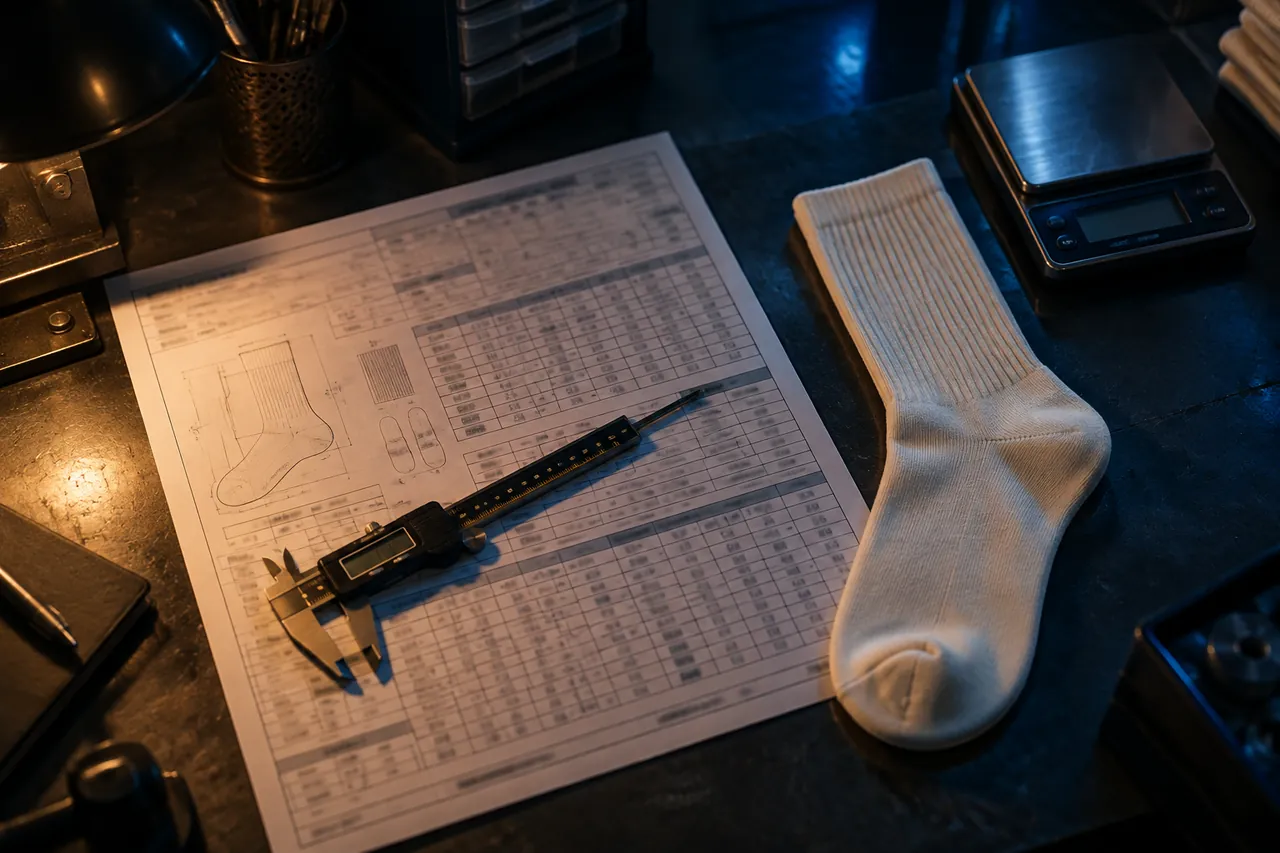
One, weigh ten pairs from the shipment against the sheet's target — average and spread, both. Two, burn-test or lab-test the fiber content against the stated blend if the program is large enough to justify it. Three, measure foot length flat, unstretched, against the knit size. Four, put the invoice next to the spec sheet and check that the description of goods matches field for field — discrepancies here are how re-labeling hides. Our OEM/ODM walkthrough explains where in the production flow each of these checks lands; the spec sheet is what makes them possible at all.
FAQ
Is a higher needle count always better? No. Needle count buys fineness and pattern detail at the cost of thickness and warmth. Dress and no-show programs want fine gauges; boot socks and work socks want coarse cylinders. Better is the pair (needle count + cylinder) that matches the product's job.
What is the difference between gauge and needle count? Needle count is the raw number of needles on the cylinder. Gauge is stitches per inch — needle count divided by the cylinder's circumference. Two sheets with identical needle counts can be different gauges on different cylinders.
What does N mean in 144N? Needles — 144 needles on the cylinder. Some sheets write "needles," others just append N to the number; they mean the same thing.
Why does my spec sheet show different blends for each zone? Because the sock is knit zone by zone, and each zone has a different job — recovery at the cuff, abrasion at the heel and toe, comfort at the instep. A single whole-sock blend is the invoice's view, not the knitting machine's.
How accurate should the stated weight be? Hold factories to ±5% on average weight per dozen, and ask how they control it — auto-weighing at the boarding line is the answer you want to hear.
Can I verify terry construction without cutting the sock? Turn the sock inside out and look at the sole: visible loops are terry. A flat-woven surface under the foot means the terry line on the sheet was aspirational.