Sock sizing looks like a conversion problem. It is not. A conversion table tells you what to print on the label; it does not tell you why one factory's "EU 39-42" fits differently than another's, how needle count caps your size range, or how to split 1,000 pairs across sizes so the medium does not sell out while the small gathers dust. Those are manufacturing decisions, and this guide covers them the way a factory handles them.
Quick answer: buy socks by foot length, not shoe size. Standard adult programs run three grades — US 9-11 / EU 36-40, US 10-13 / EU 41-46, US 13-15 / EU 47-51 — with each grade spanning roughly 1.5-2 cm of foot length. Needle count sets the ceiling: 144-needle machines are best under EU 40, 168N is the standard adult workhorse, and 200N high-gauge machines stretch both finer and wider than most brands expect. For US and EU markets in one SKU, print both standards on one label — it is cheaper than running two size curves.
The Two Systems You Are Actually Buying
Retailers in the United States inherited the sock-size system — 9-11, 10-13, 13-15 — which predates modern shoe sizing and refers to foot length in increments manufacturers still honor. Europe grades by shoe size (Paris points), where each point is 2/3 cm and a practical grade spans two to three points. When you buy a sock labeled US 10-13 / EU 41-46, you are buying one knitted form described in two dialects.
The translation layer matters at the extremes. A US women's 9 foot lands near EU 40, straddling the first two grades — which is why women's programs often run a dedicated 9-11 grade rather than borrowing the men's curve. In our programs, the crossover point where a single grade stops working is predictable: above EU 46, heel placement and cuff stretch start fighting each other, and that is exactly where the third grade earns its slot in the size chart.
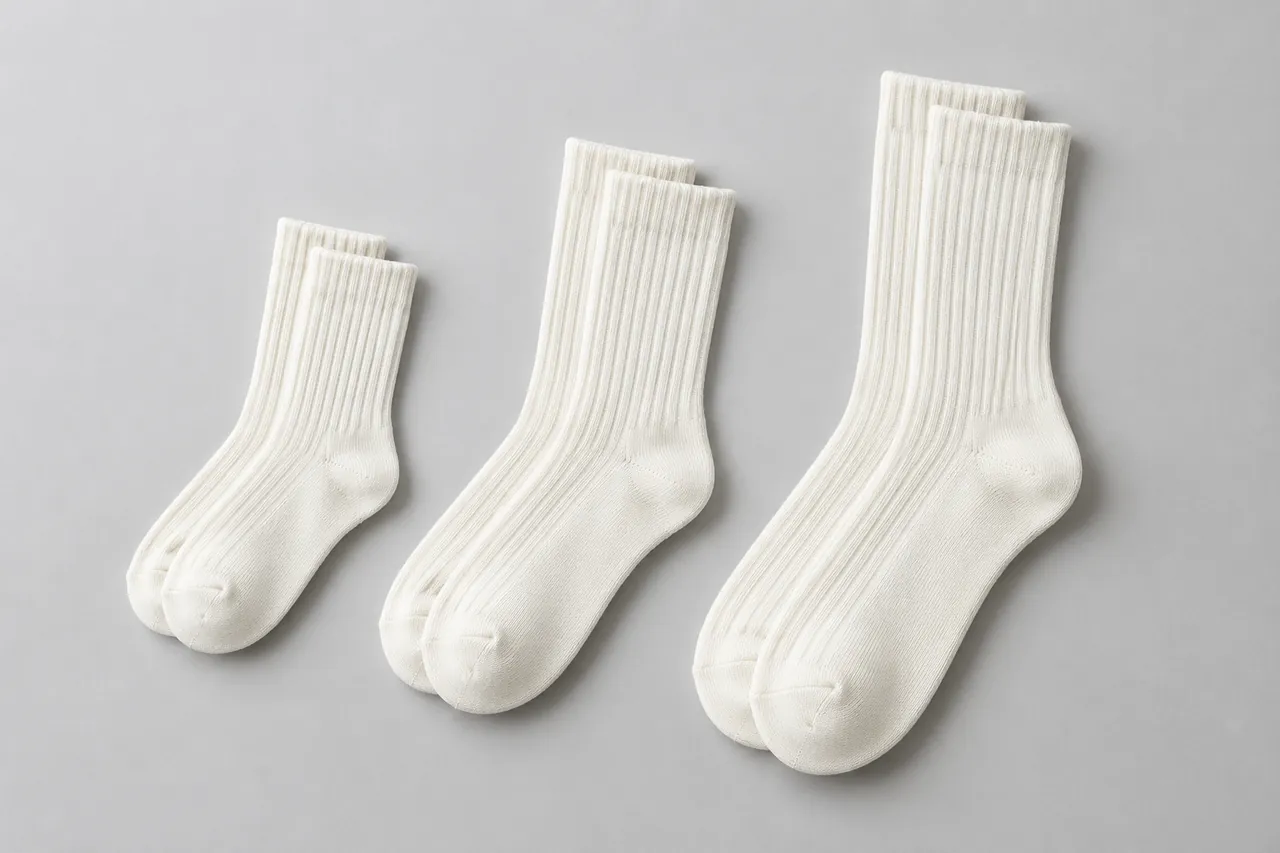
The Standard Three-Grade Curve
The chart below is the grading we run for standard adult crews and no-shows in yoga grip programs and everyday cotton lines:
| Grade | US sock size | EU shoe size | Foot length (cm) | Typical share | |---|---|---|---|---| | S | 9-11 | 36-40 | 22.0-25.0 | 25-35% | | M | 10-13 | 41-46 | 25.0-28.5 | 45-55% | | L | 13-15 | 47-51 | 28.5-31.5 | 15-25% |
The shares are not decoration — they are the starting allocation we quote for a first production run, adjusted after your sell-through data exists. One detail the conversion tables never mention: grade boundaries sit on foot length measured heel-to-toe on a brannock-style device, not on the shoe size the customer wears, because half the returns in this industry come from customers who buy socks by shoe size and wear them by foot length.
What Needle Count Means for Your Size Range
This is the part of sizing only a factory can tell you. The knitting machine's needle count — how many needles circle the cylinder — sets both the fineness of the fabric and the physical width the sock can reach:
- 144 needles knit a tighter, narrower tube. Below EU 40 it is ideal: kids' lines, women's small grades, fine-gauge dress socks. Push it past EU 44 and the fabric locks up — the sock "fits" on paper and strangles on the calf.
- 168 needles is the industry standard adult machine. It covers the full three-grade curve comfortably and handles terry, jacquard, and cushion mapping without retooling. Most custom programs quoted between 300 and 10,000 pairs run on 168N.
- 200 needles produces high-density fabric that knits finer and, with the right yarn, stretches wider than the label suggests. It is how one-size-most fashion programs reach from EU 36 to EU 45 without a second grade.
Practical consequence for buyers: if a factory quotes your entire size range on a single 144N setup, ask which grade they compromised. There is always one.
Grading Rules: Where Socks Differ from Shoes
Shoes grade in three dimensions at once. Socks grade in two — length and circumference — and the two do not move in lockstep. The foot-length grade steps 1.5-2 cm per grade, but the circumference grade steps far less, because elastane recovery (typically 3-5% spandex in the cuff and 1-2% in the body) absorbs the width differences. A size curve that adds a centimeter of length per grade may add only two millimeters of tube width.
The heel pocket is the second grading trap. On a linked-toe or reinforced-heel style, the heel splice moves backward as foot length grows; skip that adjustment and every large grade bunches at the ankle. In our tech packs, heel placement is a graded dimension with its own row in the size specification — the same status as cuff height or toe seam type. When you evaluate a factory's size chart, ask to see the graded heel position. If all grades share one number, the large will fit like the medium's oversized cousin.
Size Distribution for Bulk Orders
The three-grade shares in the chart above hide a market split worth knowing before you place a bulk order. US retail skews larger: programs we run for American chains often open at 20:50:30 (S:M:L). European programs skew smaller — 35:50:15 is common. The safest first order is boring on purpose: quote the standard allocation, sell through one season, then re-grade. The 300-pair trial tier exists partly for this — a trial split across three grades is real sell-through data for less than the cost of one full-size production slot.
Dual-Standard Labels: One SKU, Two Markets
Running separate US and EU size runs doubles your SKU count, your minimums, and your slow-moving inventory. The alternative — printing "M / US 10-13 / EU 41-46" on one label and one woven sock — is how mid-size brands keep one production run selling on both continents. The only grades where we advise against merging are compression programs, where the pressure class is certified against a specific size band and mixing standards muddies the compliance trail. For everything else — crews, no-shows, dress lines — one dual-standard grade curve is the default we recommend and quote.
Want the curve fitted to your returns data instead of the standard? Send your size-level sell-through with your inquiry — grading a curve to real customer feet is a half-day of engineering work on our side, and it is included in custom programs.
FAQ
Should I size socks by shoe size or foot length? Foot length, always. Shoe sizes vary between brands; a foot measured at 26 cm is 26 cm in every shoe. Grade boundaries in manufacturing charts are set on measured foot length, which is also why US sock sizes (9-11, 10-13) describe foot length ranges rather than shoe sizes.
What is the EU equivalent of US sock size 10-13? EU 41-46 in the standard three-grade curve. The full mapping runs US 9-11 to EU 36-40 and US 13-15 to EU 47-51, with each grade spanning roughly 1.5-2 cm of foot length.
Can one machine knit my whole size range? A 168-needle machine covers the standard adult curve, EU 36 to 51. Below EU 40, 144-needle machines produce a better-fitting, finer sock; above EU 46, expect heel and cuff adjustments rather than a simple width stretch. Needle count is a fit decision, not just a fabric decision.
How do I split sizes for a first bulk order? Start with 25:50:25 (S:M:L) for mixed markets, adjust toward 20:50:30 for US retail or 35:50:15 for Europe, and re-grade after one season of sell-through data. Trial orders from 300 pairs are the cheapest way to test the distribution before committing to full production.